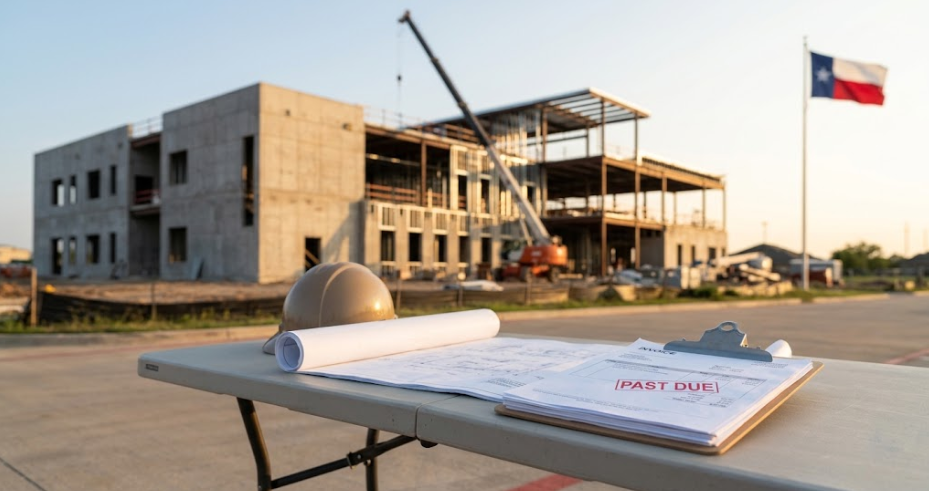


If a Texas homeowner pays you by debit or credit card and later disputes the charge, the money can be pulled back out of your account months after the job is finished, and the lien rights you gave up in exchange for that payment may already be gone.
A card chargeback is something most Texas contractors don’t see coming. A card payment looks final the day it lands. The card networks treat that payment as provisional for well over a year. But a cardholder can dispute a charge for up to 540 days after the transaction is processed. In Texas, the deadline to file a mechanics lien affidavit on a residential job is the 15th day of the third month after the month you last furnished labor or materials, which closes long before that window does. Then by the time a homeowner charges back a payment in month ten, your deadline to file a lien against the property has already passed.
This guide from The Cromeens Law Firm focuses on residential work. Homeowners pay by card, especially for deposits and final payments, and more Texas contractors accept cards every year. The convenience of taking a credit or debit card is real. However, so is the exposure to a chargeback.
A chargeback reaches further than a refund dispute. In Texas, a chargeback can void the lien waiver you signed, revive a debt you thought was settled, and leave a general contractor who already paid the subs holding the loss.
A chargeback is a reversal of a card payment that the cardholder initiates through their bank, not through the contractor who received the payment. On a Texas construction job, a chargeback means the homeowner has told their bank that the charge should not stand, and the bank pulls the money back from the contractor’s account while it reviews the dispute.
A chargeback is different from a refund. A refund is something the contractor chooses to give. A chargeback is imposed from outside, and the contractor learns about it after the money has already moved. The card networks assign each dispute a reason code, and three of them cover nearly every chargeback filed against a contractor.
The reason code matters because it decides what the contractor has to prove to win the dispute.
The Cromeens Law Firm sees the not-as-described Visa reason code 13.3 most often because homeowners reach for it when the real complaint is a disagreement over quality rather than whether the work happened. That code is the hardest to beat because the homeowner is not claiming you skipped the work. Instead, they are claiming you did it wrong.
Visa reason code 13.1: a services-not-received claim is answered with evidence that the work was completed. But a not-as-described claim Visa reason code is answered with the signed scope, change orders, and completion photos.
A Texas homeowner can dispute a card payment long after the work is finished, in some cases up to 540 days after the transaction is processed. That is nearly eighteen months, and it is the single number every Texas contractor who accepts cards should know.
The 540 days come from the card networks, not from any Texas statute. Under Visa’s dispute rules, a services-not-received claim can be filed up to 120 days from the date the cardholder expected to receive the services, with an outer limit of 540 days from the date the transaction was processed.
Because a construction job can run for months and the “expected” completion date is debatable, that 120-day clock often doesn’t start until well after the job is done. The 540-day cap is the real boundary.
Federal law sets a separate and much shorter window that contractors sometimes confuse with the network rule. Under Regulation Z, 12 CFR 1026.13, a cardholder has 60 days from the date of the billing statement to report a billing error to the card issuer.
That 60-day rule covers statement errors, such as the wrong amount or a charge the cardholder never authorized. It doesn’t cover a homeowner’s complaint that a contractor did the work badly. The quality dispute runs on the network’s clock, and the network’s clock is the long one.
For a contractor, the practical meaning is simple. A card payment received in January can be reversed the following June, and in some cases the June after that.
The Cromeens Law Firm treats a card payment as unsettled until the network’s dispute window has closed, and advises contractors to do the same.
A chargeback may make a Texas lien waiver unenforceable because Texas law gives effect to a waiver only when the contractor receives payment.
Under Texas Property Code Section 53.281, a lien waiver is unenforceable unless the claimant has received payment in good and sufficient funds in full for the lien claim. A card payment later pulled back through a chargeback was arguably never received in good and sufficient funds, so the waiver signed in exchange for that payment may not hold.
The reasoning is the same as what Texas already applies to a bounced check. A contractor who signs a waiver against a check that then bounces has not been paid. Texas courts do not treat the waiver as binding on a payment that was never cleared.
A chargeback is the card equivalent of a bounced check, with one difference that makes it worse: a check bounces within days, while a card payment can be reversed more than a year later, long after the contractor has stopped thinking about the job.
No Texas court has ruled directly on whether a chargeback voids a lien waiver. The argument rests on the plain wording of Section 53.281 and on the bounced-check analogy, both of which are strong. A contractor should treat that argument as a solid position, not a guarantee, and should not rely on it as a substitute for protecting lien rights before the payment is final.
This rule applies to any Texas construction job paid by card, residential or commercial. The Cromeens Law Firm advises contractors to assume a card payment can be reversed until the network’s dispute window closes and to sign waivers with this in mind.
On a Texas construction job paid by card, a conditional lien waiver protects the contractor, and an unconditional one does not, because an unconditional waiver states that payment has already been received.
Texas Property Code Section 53.284 sets out the statutory forms for both, and the difference between them is the whole ballgame when the payment can still be reversed.
A conditional waiver only takes effect once the payment clears. The form says, in substance, that the waiver is effective when the funds are received. If a homeowner charges back the card payment, the condition never occurred, so the waiver never took effect and the lien right survives. This form was built for exactly this situation, which is why it exists.
An unconditional waiver says the payment has been received and the lien right is released, full stop. Sign one against a card payment, and the document now states you were paid even though the money can still be pulled back. If a chargeback follows, you are left arguing that the waiver should not count because the payment failed, which is the untested argument described in the section above rather than the clean protection a conditional form gives you.
Texas law also limits the other side of the table. Under Section 53.283, no one can require a contractor to sign an unconditional waiver for a progress or final payment unless the contractor has received that payment in good and sufficient funds. A homeowner or general contractor who insists on an unconditional waiver in exchange for a card payment that has not settled is asking for something the statute does not allow them to demand.
The practical rule The Cromeens Law Firm gives contractors is simple. On any card-paid job, use the conditional form and do not sign an unconditional waiver until the card network’s dispute window has closed.
The card network’s dispute window runs far longer than the Texas deadline to file a mechanics lien, so a late chargeback can arrive after the contractor can no longer secure the debt against the property.
On a Texas residential job, the lien affidavit must be filed by the 15th day of the third month after the month you last furnished labor or materials. You can dispute a card payment for up to 540 days after it is processed.
Put real dates on it. A contractor finishes a residential remodel in March and takes the final payment by card. The lien deadline is June 15. The card network’s dispute window stays open into the following September, a full year and a half. A homeowner who charges back that final payment even six months later, in September of the same year, has taken the money back three months after the last day a lien could have been filed, and there is no way to file one now.
Filing a lien in advance to hedge against a possible chargeback is not the answer. A Texas lien affidavit must include a sworn statement of the amount owed, and if the job has been paid, there is no unpaid amount to swear to. Filing one anyway also carries risk under Texas Civil Practice and Remedies Code Section 12.002, which imposes liability for filing a lien the filer knows is not valid.
The one timing that works in the contractor’s favor is an early chargeback. If a homeowner disputes the payment while the filing window is still open, the amount is now unpaid, and the contractor can and should file the lien affidavit immediately.
Once that window closes, the lien is off the table, and what remains is a contract and collection claim against the homeowner personally. The Cromeens Law Firm advises contractors to treat the final card payment on a job as the one payment a lien cannot protect, and to consider requiring a check or bank transfer instead.
Federal law gives a homeowner who paid with a personal credit card the right to raise a quality dispute with the card issuer, and a Texas contractor working at the customer’s property almost always meets the conditions that trigger it. This right comes from the Fair Credit Billing Act, 15 U.S.C. 1666i, implemented through Regulation Z at 12 CFR 1026.12(c).
Three conditions apply to the federal claims-and-defenses right.
That last condition is what sets contractors apart. A distant merchant can sometimes defeat the claim on geography. A contractor working at the homeowner’s house cannot, because the transaction most likely happened at the cardholder’s address.
The federal claims-and-defenses right has a real limit. Courts have read it as a defense to what the cardholder still owes the issuer on that charge, not as a refund of money already paid. So the federal exposure is greatest on a large charge the homeowner has not yet paid down.
The type of card decides whether the federal claims-and-defenses right exists at all. Regulation Z exempts business-purpose credit, so an owner paying with a company card has no federal claims-and-defenses right.
Debit cards fall under Regulation E, which covers unauthorized transactions and statement errors but provides no protection for the quality of goods or services. In both cases, protection comes only from the card network’s rules, not a federal statute.
The Cromeens Law Firm sees this as another reason a personal credit card is the riskiest payment a contractor can accept on a large residential job.
A Texas homeowner who charges back a card payment for completed work still owes the contractor for that work, and the contractor’s ordinary collection remedies revive along with the debt. A chargeback reverses the payment, not the debt. That means a breach of contract claim, with attorney’s fees recoverable under Texas Civil Practice and Remedies Code Section 38.001, and a suit on sworn account under Texas Rule of Civil Procedure 185 for money owed for labor and materials.
A mechanics lien is available only if the chargeback landed while the filing window was still open. The Cromeens Law Firm walks through the full collection sequence, from demand letter to lawsuit, in its guide to what to do when a contractor doesn’t get paid.
A general contractor who receives a card payment, pays subcontractors and suppliers out of it, and then gets hit with a chargeback is out the money, with no way to recover it from the trades already paid. The subs were owed the money, and they got it. The general contractor is the one left holding the reversal.
Texas law is what puts the general contractor in that position. Under the Texas Construction Trust Fund Act (Texas Property Code Chapter 162), a payment a general contractor receives on a construction project is a trust fund held for the benefit of the subcontractors and suppliers who did the work. The general contractor is the trustee. The law requires prompt payment to those beneficiaries, so a general contractor who disburses a card payment to the subs the week it lands is doing what Chapter 162 expects.
That is the squeeze. The subs have been paid for work they performed, they have no obligation to give the money back, and the general contractor has no claim against them. When the homeowner reverses the card payment weeks or months later, the general contractor has already lost the funds and spent them as the statute required. The only remaining claim is against the homeowner for the debt the chargeback revived.
A Texas general contractor who wants the full picture of trust fund duties can read The Cromeens Law Firm’s guide to Texas construction trust funds. The Cromeens Law Firm’s practical rule for this specific problem is narrower. The card payment a general contractor passes through to subs and suppliers is the one payment that should come by check or bank transfer, because a chargeback on that money cannot be undone downstream.
A Texas construction contract can require a homeowner to bring any complaint to the contractor before disputing a card charge, and it can make the homeowner responsible for the cost of a chargeback filed for work done as agreed. A contract cannot stop the homeowner from contacting their bank.
A clause that says the homeowner waives the right to dispute a charge accomplishes nothing. The right to dispute a card charge comes from federal law and from the card network’s own rules, and the homeowner’s bank is not a party to the construction contract.
The bank processes the dispute under its rules regardless of what the homeowner signed. Regulators also watch this closely. In 2023, the Federal Trade Commission and the Florida Attorney General sued a chargeback mitigation company, Chargebacks911, over practices that made it harder for consumers to dispute charges, and the case settled for $150,000. A clause built to block disputes invites the same scrutiny.
What works in a Texas construction contract is a clause that governs the homeowner’s conduct, not the bank’s. Two provisions do the job. The first requires the homeowner to raise any complaint with the contractor and follow the contract’s notice-and-cure process before disputing the charge. The second makes the homeowner liable for the chargeback fees, costs, and attorney’s fees the contractor incurs when a chargeback is filed on work the contract shows was performed.
Neither clause binds the bank. Both give the contractor a breach-of-contract claim against a homeowner who skips the process, and that claim carries the attorney’s fees that Texas law already allows in a contract claim. Drafting must be careful, because a clause written as a waiver of the homeowner’s right to call their bank is the version that fails. The Cromeens Law Firm drafts these provisions as part of contract creation for Texas contractors who accept card payments.
When a Texas contractor receives notice of a card chargeback, the first move is to check the lien filing deadline for that job, because that deadline determines whether any security for the debt still exists. Everything else can wait a day. That cannot.
The Cromeens Law Firm handles chargeback responses and the collection that follows for Texas contractors, and the sooner the call comes after the notice arrives, the more options remain.
Every card payment a Texas contractor accepts carries a dispute window that outlasts the lien filing deadline, and that gap is where the risk lives. The protection is a short list.
If a homeowner has already charged back a payment, or you want your contract and waiver practice built to withstand one, schedule a free consultation with The Cromeens Law Firm. A card payment looks final the day it lands. Treat it as final only when the window closes.
Yes, and signing a lien waiver does nothing to stop the homeowner from disputing the charge with their bank. The waiver determines whether the lien right survives the reversal. Under Texas Property Code Chapter 53, a waiver takes effect only upon receipt of payment in good and sufficient funds, so a conditional waiver leaves the lien intact, while an unconditional one leaves the contractor arguing that the payment never counted.
At the card network level, yes. A debit chargeback runs on the same network dispute rules and the same long window, and it threatens a Texas lien waiver in exactly the same way, because the waiver statute turns on whether payment was received, and a reversed debit payment was no more received than a reversed credit payment.
The one difference is federal: the claims-and-defenses right under the Fair Credit Billing Act applies to personal credit cards, while debit cards fall under Regulation E, which gives no protection for disputes over the quality of the work.
Yes, with limits. Cards are fine for deposits and progress payments when the contractor uses a conditional lien waiver for each one. The Cromeens Law Firm advises against using a card for the final payment on a job or for any payment a general contractor will pass through to subs, because those are the payments a chargeback can hurt most and a lien cannot protect.

Karalynn Cromeens is the Owner and Managing Partner of The Cromeens Law Firm, PLLC, with over 17 years of experience in construction, real estate, and business law. A published author and passionate advocate for contractors, she has dedicated her career to protecting the businesses her clients have built. Karalynn is on a mission to educate subcontractors on their legal rights, which inspired her books Quit Getting Screwed and Quit Getting Stiffed, as well as her podcast and The Subcontractor Institute.