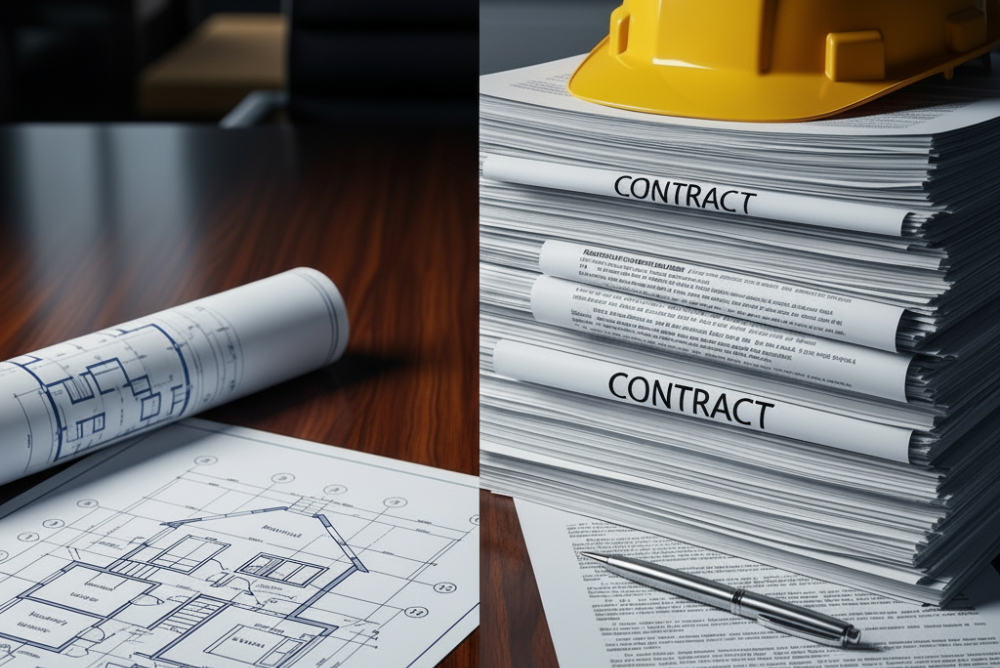
A construction subcontract is a minefield disguised as a business agreement. Buried within the standard terms and legal boilerplate are provisions designed to shift risk away from the general contractor and directly onto your shoulders. If you don’t know what to look for, you could be agreeing to work for free, pay for others’ mistakes, […]

If you’ve ever worked on a private commercial job, you know the drill when payment issues arise: you file a mechanics lien. It’s a powerful tool that attaches to the property itself, forcing owners to pay attention to your unpaid invoices. But what happens when you pour concrete for a new city hall or install […]

Think of a construction contract like a marriage. It starts with excitement, big dreams, and a promise to build something lasting. But what happens when the dream project turns into a nightmare? When unforeseen issues arise or the client relationship sours, you need a way out. That’s where an escape clause comes in—it’s the prenup […]

If you’re a contractor doing business with Texas state agencies, universities, or other government entities, you need to understand the dramatic changes that just happened to the state’s contractor certification programs. In December 2025, Texas eliminated its decades-old Historically Underutilized Business (HUB) program and replaced it with a narrower program focused exclusively on service-disabled veterans. […]

When you bring subcontractors onto a project, you’re not just adding extra hands—you’re taking on extra risk. From homeowner disputes to potential legal issues with the subs themselves, things can get messy fast. That’s why having a well-drafted contract with each of your subcontractors is essential. In this article, we’ll break down why these agreements […]
As a residential contractor, you’ve likely been there: the sixth call from a homeowner about a tiny detail—a light switch feels “off,” a cabinet needs a slight adjustment. You fix it, only to get another call days later. And then another. Suddenly, what should have been a completed project turns into an endless cycle of […]

If you asked ChatGPT to frame a wall, you wouldn’t trust the result. It doesn’t know how to hold a hammer, it can’t read a warped stud, and it certainly won’t know when the local inspector is having a bad day. Yet, many residential contractors are starting to trust AI to build something just as […]
As a residential contractor, you know that a solid contract is the foundation of any successful project. It sets expectations, defines responsibilities, and protects both you and your client. You may have heard about AIA contracts and wondered if they are the right choice for your business. While these documents have their place, they are […]

You did the work, sent the invoice, and waited for payment. When it never arrived, you took the necessary step to protect your business: you filed a mechanic’s lien on the property. You’re now waiting, hoping the lien will prompt the owner to pay up. Then, a thick envelope from the clerk of real property […]

As a contractor, few things are more frustrating than not getting paid for your hard work. You’ve held up your end of the bargain, but the payment isn’t coming through. In today’s construction industry, this scenario is all too common. 82% of contractors now face payment delays exceeding 30 days, up from just 49% two […]